
Gold soars, energy policy burns: WA Mining Club panel drops truth bombs on 2025 outlook

, , ,
,
, , ,
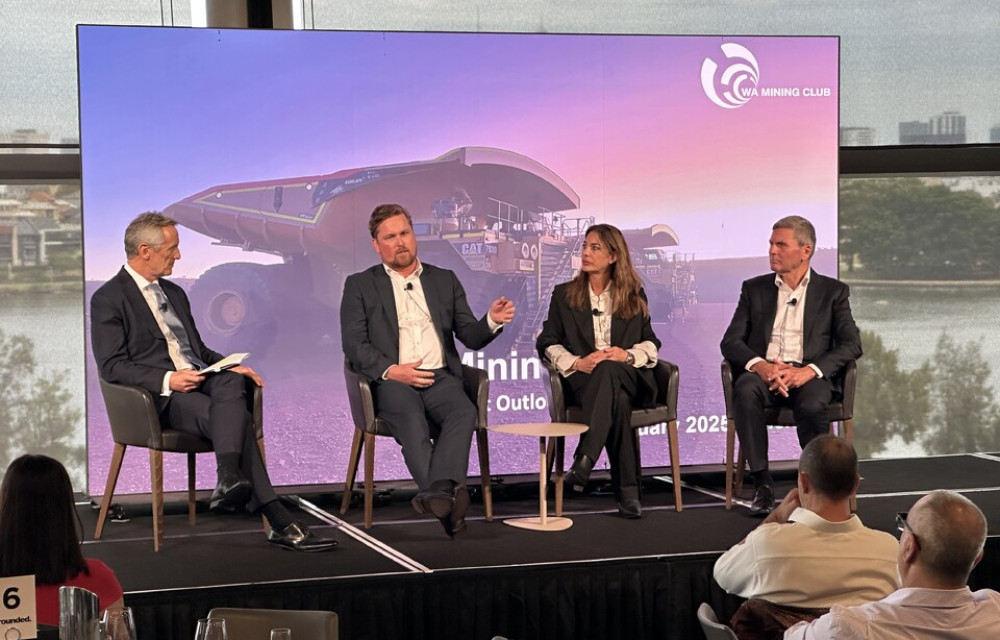
The WA Mining Club’s first luncheon of the year at Optus Stadium’s River Room was more than just a market outlook—it was a sharp-edged critique of Australia’s economic and energy policies, a deep dive into gold’s meteoric rise, and a call for industry leaders to reclaim their voice in shaping the country’s future.
Energy Policy Under Fire: “A Group of Six-Year-Olds with Crayons”
Chris Uhlmann, Walkley Award-winning journalist and former ABC political editor, didn’t hold back in his scathing assessment of Australia’s energy policy. Speaking as part of the Market Outlook 2025 panel, Uhlmann dismantled the current approach to renewables and net zero, calling it economic self-sabotage that is pushing energy prices higher while de-industrialising the country.
“Australia exports uranium but refuses to use it. We export six times more coal than we burn but won’t burn it here. We are building an electricity grid based on wind and solar, yet we have banned gas exploration in Victoria and New South Wales,” Uhlmann said.
“A group of six-year-olds with crayons would struggle to come up with something more incoherent.”
His argument was clear: the net zero push is unrealistic, given that China, India, Russia, and now the US are not fully committing to it. Meanwhile, Australian industries are being burdened with soaring power costs and an energy strategy that relies on intermittent renewables while demonising the very fossil fuels required to keep the grid stable.
“If we continue on this path, we are heading towards economic decline,” Uhlmann warned. “It’s time for Australia’s industry leaders to speak up.”
Beyond energy prices, Uhlmann pointed out the broader economic implications, highlighting that Australia’s heavy reliance on imported liquefied natural gas (LNG), despite having abundant domestic reserves, is a symptom of poor policy planning.
“We’ve tied one hand behind our back while pretending we’re leading the world,” he said. “Our industries, from mining to manufacturing, are now dealing with the consequences of these flawed policies.”
The discussion also touched on nuclear energy, with Uhlmann arguing that Australia is one of the few developed nations refusing to consider it as a viable alternative. He pointed to South Australia as a potential hub for uranium enrichment and nuclear power generation, emphasising that it could provide both economic and energy security benefits.
The Case for Gold: A Safe Haven in Uncertain Times
While energy dominated much of the discussion, the outlook for gold provided a strong contrast—an asset thriving amid global economic uncertainty. Canaccord Genuity Australia mining analyst Tim McCormack highlighted that gold prices have surged 40% year-to-date, fuelled by geopolitical instability, central bank buying, and a weakening trust in fiat currencies.
“Gold is no longer just a hedge against inflation; it’s a hedge against uncertainty,” McCormack explained. “Central banks now hold around 35,000 tonnes of gold in reserves, making it the second-largest reserve asset globally after the US dollar.”
McCormack also touched on the role of Trump’s potential return to the White House, suggesting that his presidency could bring further volatility and instability to global markets, which historically drives gold prices higher.
“The Trump factor is real,” he said. “Markets don’t know how to price it in, which makes gold an even more attractive asset.”
Additionally, McCormack pointed out that despite the record-high prices, Australian gold equities remain undervalued, presenting a unique investment opportunity.
“Many producers are still trading at a discount to their underlying asset value,” he said. “With sustained demand and limited new supply, we could see significant upside.”
Mining M&A: Strategic Consolidation in Gold and Beyond
Emma Scotney, non-executive director of De Grey Mining and Minerals 260 Limited, highlighted the heightened merger and acquisition (M&A) activity in the gold sector. The $4.9 billion Northern Star takeover bid for De Grey Mining was cited as an example of strategic moves being driven by both gold price strength and asset scarcity.
“We’ve seen strategic positions taken, mergers of equals, and full takeover offers,” Scotney said. “In De Grey’s case, we were well-prepared, knew the value of our asset, and were able to extract a compelling premium.”
The broader discussion on M&A extended beyond gold, with the panel noting that private equity is playing a growing role in mining transactions. Some panellists expressed concerns that this trend could lead to a wealth transfer away from public shareholders and into private investment firms.
ASX’s Regulatory Chokehold: Liam Twigger Calls It Out
Panel host Liam Twigger of Argonaut didn’t hold back on the regulatory stranglehold of the ASX, warning that overreach and excessive compliance costs are making Australian markets less attractive for companies looking to list.
“The burden of ESG compliance, governance requirements, and red tape is suffocating capital formation,” Twigger argued. “We are seeing a shift where companies are choosing to stay private or list elsewhere, rather than deal with the ASX’s growing list of regulations.”
Twigger pointed out that while regulatory frameworks are essential, the current trajectory is discouraging innovation and investment, particularly in the junior mining and exploration sector. He noted that the number of IPOs has significantly declined, with many emerging companies opting for private equity funding or overseas listings instead.
“The ASX is in danger of becoming a market that favours bureaucrats over entrepreneurs,” he said. “At a time when we need investment in critical minerals and resources, we’re making it harder for companies to access capital.”
Twigger called for a more balanced approach to regulation, one that supports corporate responsibility while ensuring that Australia remains a competitive destination for investment and capital markets.
Political and Economic Uncertainty: What’s Next?
With a federal election looming, the panel agreed that cost of living would be the defining issue. “Energy prices are a key component of this crisis,” Uhlmann noted, pointing out that the government is now subsidising power bills due to policy-driven price spikes.
He also warned of broader geopolitical shifts, describing the unravelling of the post-World War II global order and rising tensions between the US and China. “We’re entering a new era of uncertainty, and gold isn’t the only thing people should be hedging,” he said.
A Call to Action: Industry Must Find Its Voice
The event closed with a strong call to action for industry leaders to push back against flawed policies that are damaging Australia’s economic position. Uhlmann urged mining executives to take a more vocal role in shaping policy, particularly around energy security and resource development.
For those in attendance, it was clear: 2025 is shaping up to be a year of both opportunity and challenge. The path forward will depend on whether Australia’s resource sector chooses to lead the debate—or be dictated to by it.